

Tower Moments

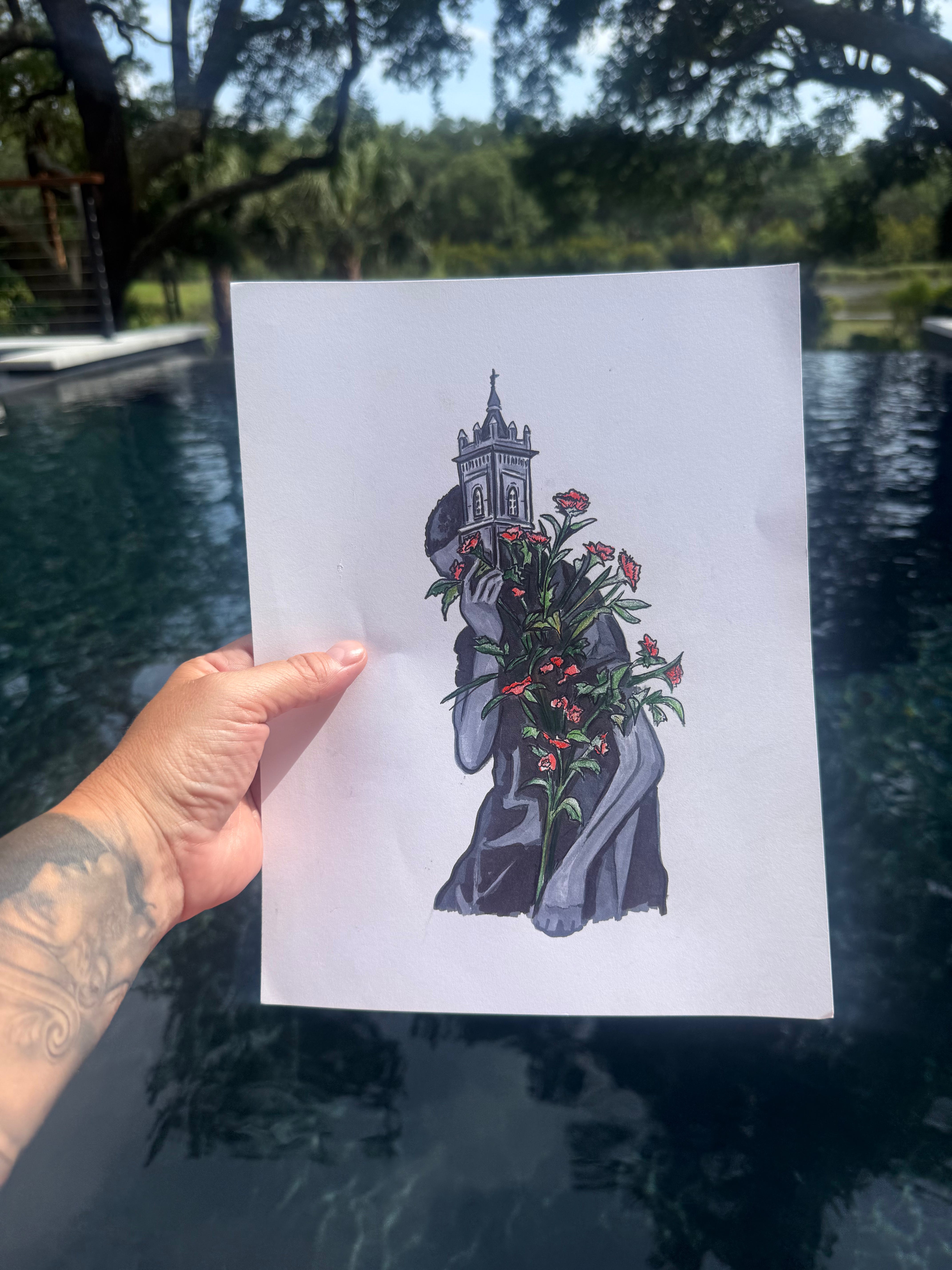
In this drawing, a man bends beneath that invisible gravity. One arm lifts a tower toward his hidden face, as though he has become both its builder and its prisoner. Towers have always fascinated humanity. We raise them to touch heaven, defend kingdoms, display power, or leave behind proof that we existed. Yet every tower is also a wall. Every fortress is built because something inside fears what waits beyond its gates. Perhaps our emotional architecture is no different. There is a moment just before a cathedral is finished when it resembles both a sanctuary and a prison. Stone upon stone, each placed with devotion, each carrying the promise of protection. We have inherited that instinct. Long before we learn to trust another person, we learn to build. We stack silence where language once lived. We mortar disappointments into certainty. We crown ourselves with independence and call it wisdom. By the time someone says, “You don’t have to carry this alone,” we have forgotten that the architecture was ever optional.
The figure bends beneath this inheritance. His body does not collapse so much as negotiate with gravity, as though every unseen memory has quietly claimed a place upon his shoulders. One hand lifts a tower toward his face, not to admire it, but almost to disappear behind it. The other cradles an unruly gathering of crimson flowers, the only rebellion against a world drained to black and white. His face is absent, hidden by both stone and bloom, and that absence feels strangely familiar. We spend astonishing portions of our lives introducing people to the things we’ve built while sometimes withholding the person who built them.
Perhaps that is why castles have always inspired equal measures of admiration and loneliness. They are monuments to survival, but survival has peculiar tastes. It asks for vigilance in exchange for safety. It convinces us that every healed wound should remain wrapped, every unlocked gate is an invitation to loss. Eventually the walls no longer separate danger from peace; they separate memory from possibility. We become curators of our own fortresses, polishing the towers while forgetting the sky was always meant to be visible from the courtyard.
Then there are the flowers that are held almost carelessly, as if they belong to another life. Color enters the drawing like truth enters a conversation: without permission and impossible to ignore. Red has never merely been the color of love. It is the color of first breath, of warning flares, and of autumn surrendering its leaves so spring can negotiate with empty branches. The flowers refuse decoration. They insist on pulse. They remind us that the softest things in nature often survive the longest. Rivers outlive mountains not because they are stronger, but because they understand the impossible patience of yielding.
There are people who arrive in our lives carrying hammers, convinced every wall is a problem to solve. They sometimes leave with bruised hands and stories about how impossible the walls were. Then there are others who never touch the stone. They notice the wildflowers growing between the cracks. They understand that trust behaves less like a key than like springtime. It cannot be forced. It returns because something beneath the frozen ground quietly decided it was time. Some individuals seem to possess an uncanny ability to see around our towers. They do not arrive carrying battering rams or demanding entry. Instead, they sit outside the gates long enough for us to realize they never intended to conquer the castle in the first place. They remind us that trust is not built through persuasion but through presence and time. It’s about consistency of care. In a culture that rewards performance and productivity, they offer something far rarer: permission to be unfinished. They see the flowers before they see the walls, and somehow that changes how we see ourselves. It changes how we show up.
The hidden face lingers long after the eye leaves the page. It asks a question the tower cannot answer: How much of ourselves has been buried beneath the effort of becoming someone who cannot be hurt? Somewhere along the way, many of us traded wonder for certainty, openness for competence, and tenderness for composure. We became fluent in carrying what should have been shared. We learned to mistake endurance for identity. Yet no tree mistakes its bark for its life. The living part has always been hidden just beneath the surface, carrying water toward branches that still believe in light.
For me, that is what this image has been reaching toward all along. Not the romance of brokenness, nor the triumph of healing, but the strange coexistence of both. We are all walking through the world carrying our private cathedrals in one hand and our untended gardens in the other. One reminds us what we survived. The other whispers what is still capable of blooming. The tragedy is not that we possess both. The tragedy is that we so often offer the stone to strangers while keeping the flowers hidden from those who would have known exactly how to hold them.
In the end, the figure never asks us to choose between strength and softness. He asks something far more unsettling: to consider whether they were ever opposites at all. Perhaps the strongest among us are not those who build the highest towers, but those who eventually discover that roots can accomplish what walls never could. Roots do not defend. They connect. They disappear into darkness only to make life visible above the ground. And in my experience that has always been the quieter miracle in that beneath every guarded heart is not a kingdom waiting to be conquered, but a garden waiting for someone, including ourselves, to believe it is safe enough to grow. The drawing leaves us with no clear resolution, and maybe that is its greatest truth. None of us arrives at a final version of ourselves where every wall has fallen and every wound has healed. Life is less about demolishing our castles than learning which gates should remain open and who has earned the privilege of walking through them. We all carry towers built from old fears, and we all carry flowers capable of bringing unexpected beauty into someone else’s life. The question is not whether we have both. The question is which one we allow the world to encounter first, and whether we are brave enough to believe that the parts of us we protect so fiercely may also be the very parts waiting to be shared.