

The Space Between

True reflection has shown me that I’m someone that has spent my life protecting myself from the very thing I spend nights praying for. I think my own journey is similar to a lot of people I’ve grown to care about.
We build walls and call them standards. We call distance independence. We convince ourselves that needing no one is strength because dependence feels dangerous. If no one gets close enough to your heart, then no one gets close enough to break it. It feels safe. Until one day you realize you’ve become the architect of your own outcomes. The tragedy isn’t that people have hurt us. The tragedy is that we often hand our future connections the sentence for crimes they never committed.
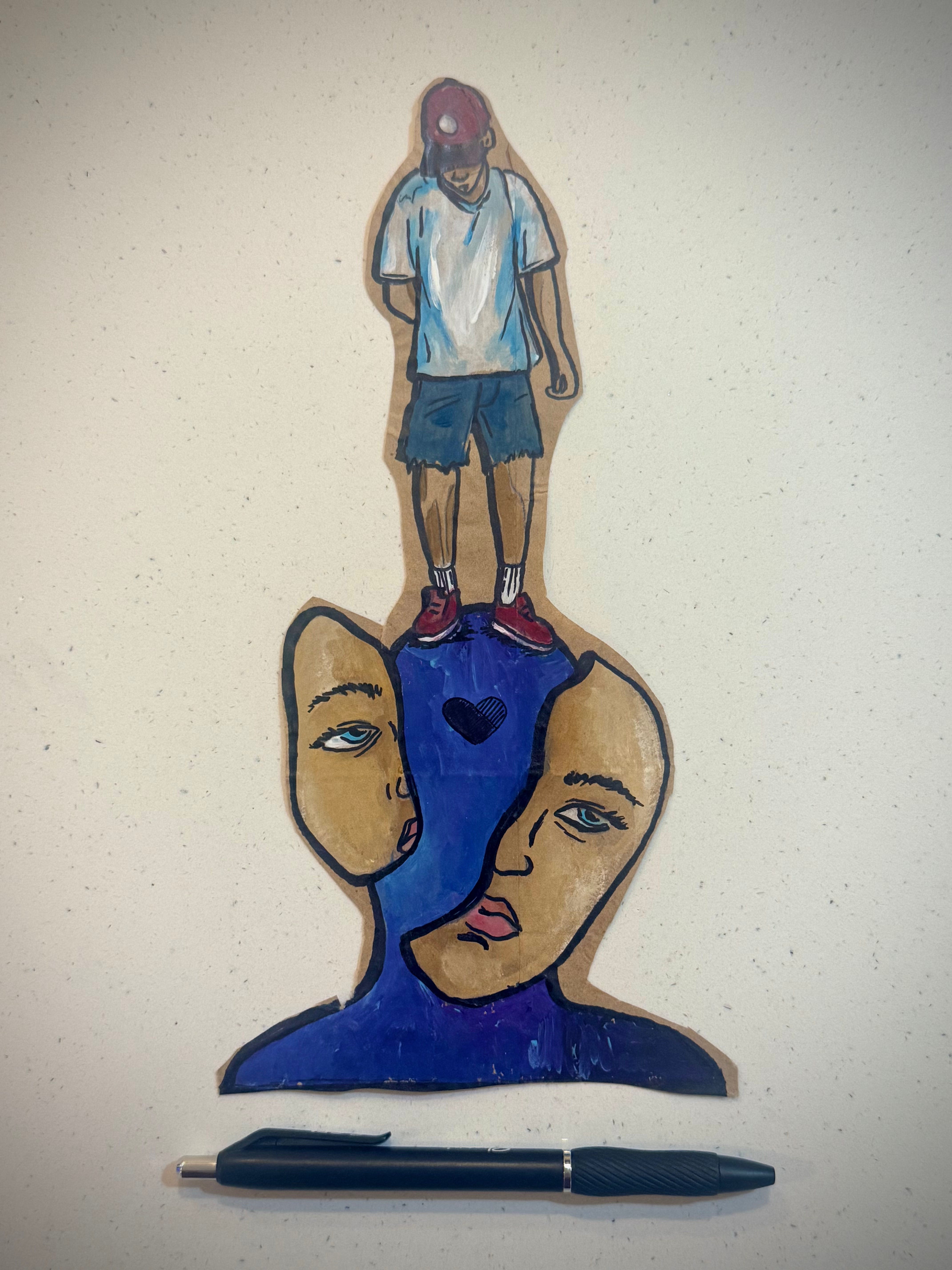
My drawing lives inside that paradox. A man stands above a woman whose head has split open, revealing not chaos, but an entire universe at her core. At its center is a solitary heart. It’s quiet, waiting, and almost sacred. The opening isn’t destruction. It’s revelation. We often imagine vulnerability as something taken from us, like it’s something that can be stolen, but perhaps it is the only way our deepest self can finally be seen. We fear that allowing someone into our inner world will cost us our freedom or we fear future pain so we stand on guard. Yet the safest connections don’t imprison us; they expand us. They remind us that autonomy and intimacy were never enemies. Real connection doesn’t ask us to become smaller. It gives us enough space and safety to become more of who we already are.
Avoidant hearts know this tension better than anyone. We crave connection with one hand while pushing it away with the other. We fear being consumed, controlled, abandoned, or even misunderstood. Independence becomes our armor, and eventually, our prison. We become so skilled at surviving alone that we forget humans were never designed merely to survive. We were designed to witness one another. Sometimes it takes extraordinary people (one or more) in our lives, not because they save us, but because they remain patient enough to stand beside us while we slowly lower the drawbridge. They show us that vulnerability isn’t surrender. It is trust. And trust is where freedom begins. I learned this the hard way.
That reminds me of something profound that Inky Johnson once said: “God doesn’t give us the people we want. He gives us the people we need…to help us, to hurt us, to leave us, to love us, and to make us into the person we were meant to be.” His words always make me reflect deeply and I value the lessons he’s helped me learn as I listen to his messages. At first, those words can feel cruel. Why would the people who hurt us also be necessary? Because every meaningful connection leaves fingerprints on who we become. Some teach us what love feels like. Others teach us what boundaries look like. Some stay forever. Others leave just long enough to expose the places inside us that still needed healing. None of them are wasted if we allow the experience to shape us instead of harden us. The goal now is to remain open despite the past.
That truth echoes through one of my favorite books, it’s called: Into the Wild. Christopher McCandless, gave up his life savings and left society to be alone in the wild. He spent much of his journey believing freedom meant complete self-reliance, stripping life down until only he and the wilderness remained. Yet near the end of his life, while living in an abandoned bus in Alaska, after chasing solitude to its absolute edge, and as he died, he wrote the words that have echoed through generations: “Happiness is only real when shared.” That one sentence wasn’t simply about companionship. It was an awakening. He discovered that joy is not a destination waiting beyond achievement or isolation. It lives in the exchange between hearts. Peace is born when our experiences, our burdens, our laughter, and even our grief are witnessed by someone else who can hold them gently. His final realization in absolute solitude, while offering freedom, strips joy of its true value, because human connection and love give life its real meaning.
I like to think that is why we never truly arrive as finished people. We aren’t meant to. Somewhere along the way we were taught that we must completely find ourselves before we deserve connections, as though they are rewards for perfection instead of places where transformation can happen. But the right people don’t demand a polished version of us. They meet us inside the unfinished chapters. They hold space for our fears without feeding them. They celebrate our strengths while gently confronting the parts of us still hiding in the dark. They become mirrors, not reflecting only who we are, but revealing who we could become. Sometimes the greatest act of care isn’t making someone feel comfortable. It’s caring for them enough to crack them open so that the universe they have spent a lifetime protecting can finally breathe. It’s scary, but necessary.
Maybe that’s the real symbolism hidden inside the fracture. The heart at the center isn’t broken. It isn’t missing. It has been waiting. Waiting for courage to outrun fear. Waiting for the right eyes to look inside without trying to possess what they find. Because connecting isn’t a possession, it is permission. Permission to become more fully yourself. We spend so much of our lives believing we have to choose between independence and intimacy, as if opening ourselves to another person means surrendering pieces of who we are. But the healthiest connections ask for neither sacrifice nor self-abandonment. They create a space where two people can continue becoming who they are while choosing to walk beside one another. This is true in friendship or romantic connections. We don’t pause our own journey when we find the right person or people. We continue it, staying on our individual paths, but with someone who challenges us, steadies us, celebrates us, and reminds us that growth was never meant to happen entirely alone.
Maybe courage isn’t found in standing in isolation or in search of self. Because the right connection won’t ask you to lose your independence. It will give you the confidence to pursue it even more boldly. No matter where it takes you. In the end, connection isn’t about finding people to finish your story. It’s about finding those who inspire you to keep writing it. The artwork shows us that the space between is where people remain truly themselves while having the courage to be seen. It’s not about losing ourselves in someone else, but connecting in a way that it allows someone access while we become ourselves. Connection and individuality aren’t opposing forces. The courage isn’t in choosing one over the other. It’s in trusting that both can exist at the same time. I’ve learned that healthy connections don’t erase independence, they honor it.